Thứ Bảy, 8 tháng 8, 2015

Russian PAK FA Fifth Generation Fighter Performs Spin Maneuver (VIDEO)

The Sukhoi PAK FA once again proved its flying superiority and outstanding technical capabilities

The newest Russian jet fighter was caught on camera smoothly performing the famous spin maneuver.

The video published by the TV channel Zvezda shows a PAK FA prototype easily decelerate to 0 kmh and perform a spin without a flaw.

As for maneuvering capabilities, the T-50 is considered to have absolutely no rivals both among its Russian-made predecessors and foreign competitors.

For a regular jet fighter, there is nothing special in performing some aerobatic maneuvers. However, the PAK FA is capable of performing them all, including Nesterov’s loop, tailside, barrel roll, and even cobra.


According to test pilots, at least two-three new maneuvers are being designed for the PAK FA.

The PAK FA is a single-seat, twin-engine jet fighter, and the first operational aircraft in Russian service to use stealth technology.

It was designed by the Sukhoi Design Bureau.

The aircraft will be used to achieve air superiority and assist in ground attacks. Besides its ability to fly at speeds well above Mach 2, the T-50 boasts other, even more important, features such as invisibility to radar and powerful weapons which will be unveiled later.

The use of composite materials, innovative technologies, advanced avionics and engines ensure the T-50’s extremely low level of radar, optical and infrared visibility.

In December 2014, Russia’s United Aircraft Corporation announced that production of the fighter was ready to begin in 2016. Fifty-five PAK FA jets will enter service in the Russian Air Force by 2020.

Sputnik News

China accuses Manila, Tokyo of joining forces over South China Sea


Japan and the Philippines teamed up at a regional security forum this week to attack China over the disputed South China Sea, China's Foreign Ministry said, detailing the feisty defense its foreign minister mounted in return. China claims most of the South China Sea, through which $5 trillion in ship-borne trade passes every year. The Philippines, Vietnam, Malaysia, Taiwan and Brunei also have overlapping claims.

U.S. Secretary of State John Kerry on Thursday accused China of restricting navigation and overflights in the contested waterway, despite giving assurances that such movements would not be impeded. Addressing the East Asia Summit in Kuala Lumpur, Kerry said China's construction of facilities for "military purposes" on man-made islands was raising tensions and risked "militarization" by other claimant states.

In a statement released just before midnight on Thursday, China's Foreign Ministry said the Philippines foreign minister "attacked" China's South China Sea policy, and received support from his Japanese counterpart.

"First off, the situation in the South China Sea is generally stable, and there is no possibility of a major clash," the statement cited Chinese Foreign Minister Wang Yi as telling the forum, which was attended by foreign ministers from around the region.

"China opposes any non-constructive words and acts which widen division, exaggerate antagonism or create tensions." China is also concerned about freedom of navigation, but to date there have been no instances of this being compromised, he added.

China is the real victim in the South China Sea, Wang told the forum, pointing to what he said was the "occupation" of some of its islands there, including by the Philippines.

"But to maintain and protect the peace and stability of the South China Sea, we have maintained huge restraint," he added.

Turning to Japan, Wang said Japan had built up a remote island in the Pacific called Okinotori to enforce Japanese territorial claims.

China has previously refused to recognize Tokyo's claims to an exclusive economic zone around Okinotori, which lies about halfway between Guam and Taiwan, 1,700 km (1,050 miles) from Tokyo. It is also known as Douglas Reef or Parace Vela. "Before criticizing others, Japan must first take a good look at its own words and behavior," Wang said. Chinese reclamation and building work on its islands in the South China Sea are to improve living conditions and provide facilities like light houses and weather stations, he added. Reuters

While America builds carriers, China builds islands.

What should the U.S. do about China’s increased assertiveness in the South China Sea? Beijing claims almost the whole sea—land formations, seabeds and open waters alike—and of late has been literally creating new facts on the ground, constructing 2,000 acres of artificial islands where only shoals or sand bars once existed. Beijing now says those efforts are nearly complete but acknowledges plans to place military assets on the islands, some of which may include substantial airfields.

A June 2015 satellite image of Fiery Cross Reef in the Spratly Islands, part of China’s land reclamation project in the South China Sea. Tonglian/Zuma Press

Washington is deeply concerned and should continue pushing back against any Chinese enforcement of its “nine-dash line” claim to 85% of the region’s map. But the U.S. can’t stop China from building or modestly militarizing its new islands, nor should it try.

Even if it rattles nerves from Tokyo to Manila, Hanoi and Washington, Beijing’s campaign is little more than an asymmetric way of establishing regional military presence—and one that even mimics American behavior over the years.

The U.S. builds ships such as aircraft carriers and sails them into the South China Sea. And it should continue to do so.

The U.S. Navy’s role in protecting the global commons has been a huge boon to world stability and prosperity—including China’s—for decades. Beijing, struggling to learn the art of aircraft-carrier operations with its one midsize carrier, is trying to establish regional military presence in its own way.

While America builds carriers, they build islands.

Full story: http://www.wsj.com/articles/chinas-unsinkable-aircraft-carriers-1438880237

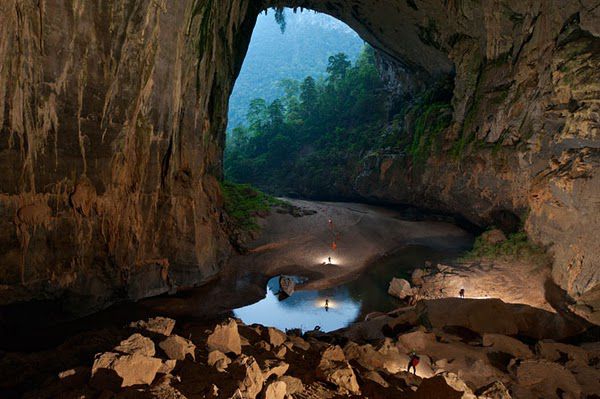
Quang Binh youth playing violin at majestic En Cave


Hang En Cave (Hang Én) is the world’s 3rd largest cave located in Quang Binh - the central province of Vietnam, succeeded only by Deer Cave in Malaysia and Hang Son Doong, also located here in the Cave Kingdom of Vietnam, Phong Nha-Ke Bang National Park.